October 2, 2026
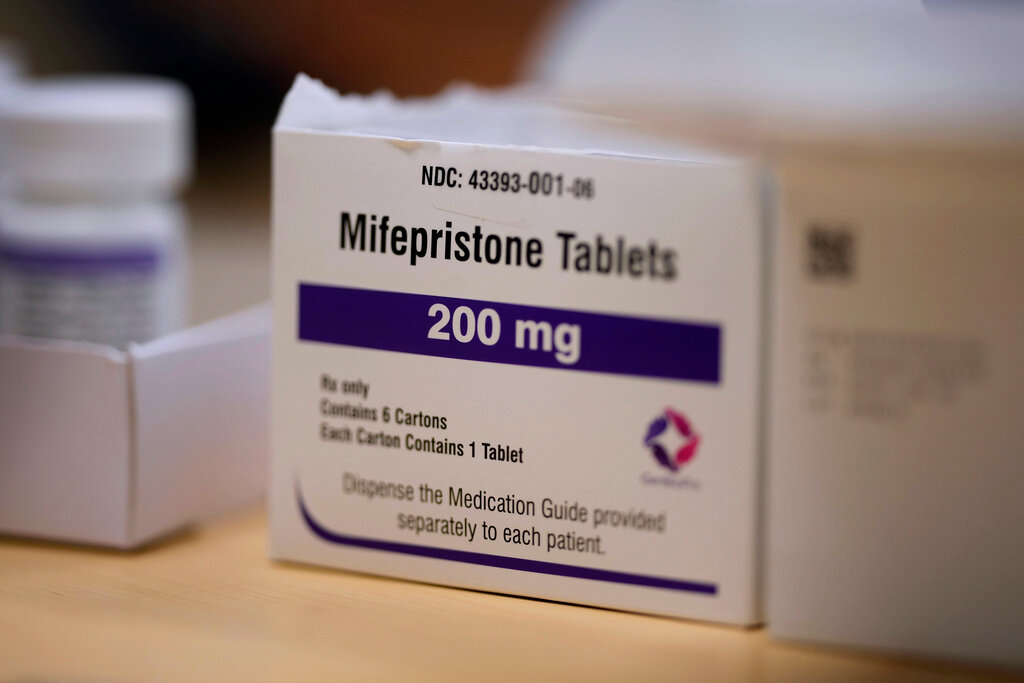
As states that already ban abortion look to further restrict access this year, much of the focus is on pills sent by out-of-state providers.
A survey released Tuesday helps explain the emphasis. It suggests that more women in states with bans obtained abortions last year using the pills prescribed via telehealth than by traveling to places where it's legal.
Most of the states with the political will to impose broad bans have already done so in the nearly four years since the U.S. Supreme Court overturned Roe v. Wade and opened the door to enforcing them. So far this year, just one state has a new one.
South Dakota Gov. Larry Rhoden, a Republican, signed a bill last week that makes it a felony to advertise, distribute, or sell abortion pills.
Similar measures have cleared both legislative chambers in Mississippi this year. There, the House and Senate would need to iron out differences between their versions before it can be sent to Republican Gov. Tate Reeves.
A survey of state abortion policies from the Guttmacher Institute, which supports abortion rights, finds that at least three states — Florida, Oklahoma and Texas — already have laws that specifically ban providers from mailing the pills to patients. Louisiana has classified one of the drugs, mifepristone, as a controlled dangerous substance.
Bills intended to keep out the pills have cleared one chamber of the legislature in Arizona, Indiana, and South Carolina this year. Republicans control the legislatures in all three states and the governor’s office in two of them. But in Arizona, any restrictions that pass could be vetoed by Democratic Gov. Katie Hobbs.
A Guttmacher survey released Tuesday sheds light on why pro-life activists be focusing on pills.
The report suggests that in 2025, for the first time, more women in the 13 states that ban abortion at all stages of pregnancy obtained pills through telehealth than traveled to other states for abortion.
The prescriptions come from providers in states with laws adopted since Roe was overturned that are intended to protect those who prescribe abortion pills to patients in states with bans.
The estimated increase in mailing pills comes as Guttmacher's estimates also suggest fewer women are traveling to states like Colorado, Illinois, Kansas, and New Mexico for abortion.
Guttmacher's estimates are based on data from a monthly survey conducted among a random sample of U.S. abortion providers, combined with historical data from every provider in the U.S.
That follows a trend that's been documented in other surveys of abortion providers.
Multiple states have court challenges to the federal rules that allow the abortion pill mifepristone to be prescribed via telehealth.
If they could require in-person prescriptions, it would at least dent the ability of out-of-state providers to get pills into places with bans in place.
Louisiana has such a lawsuit in federal court there; the attorneys general of Florida and Texas have one in Texas; those two states, along with Idaho, Kansas, and Missouri, are making the same case in a Missouri court.
Meanwhile, Texas has filed civil cases and Louisiana criminal ones against providers accused of sending pills into their states.
The Food and Drug Administration last year approved a generic version of mifepristone.
Wyoming is the only state this year that has imposed a new abortion ban.
Under a law signed in March by Republican Gov. Mark Gordon, it became the fifth state with a ban on abortion at about six weeks’ gestational age, once cardiac activity can be detected.
Courts have rejected previous Wyoming efforts to limit abortion.
The Wyoming Supreme Court in January struck down a ban on abortion at all stages of pregnancy.
No state has adopted a measure intended to allow criminal prosecutions against women who have abortions. Proposals to do so keep getting made but sputter early in the legislative process.
The farthest such a bill has made it was a hearing last year before a Senate subcommittee in South Carolina. One was scheduled for a subcommittee hearing in Tennessee this month, but didn’t get one.
The major established pro-life groups oppose the approach. “Women require compassion and support,” said Ingrid Duran, the state legislative director for National Right to Life. “Not prosecution.”
Melissa Murray, a professor at New York University School of Law, says that introducing bills with penalties against women can break down the idea that such policies are off-limits.
“You keep pushing the boundary, pushing the envelope, eventually you will get what you’re seeking,” Murray said. “It will no longer feel fanciful or shocking.”
She also noted that women are already sometimes charged with crimes related to their pregnancies. This month, police in Georgia charged a woman with murder after allegedly using an abortion pill and the opioid painkiller oxycodone.
Abortion questions will be before voters in at least three states in November.
Missouri lawmakers are asking voters to repeal the right to abortion that voters added to the state constitution in 2024.
Elsewhere, voters are being asked to add constitutional amendments that largely mirror current state abortion laws.
In Nevada, a state constitutional amendment to allow abortion until fetal viability — generally considered to be sometime after 21 weeks of pregnancy — passed in 2024. But it needs voter approval a second time to take effect.
A Virginia measure on the ballot would guarantee access to contraception, and allow abortion during the first two trimesters of pregnancy.
Share with others


