October 2, 2026
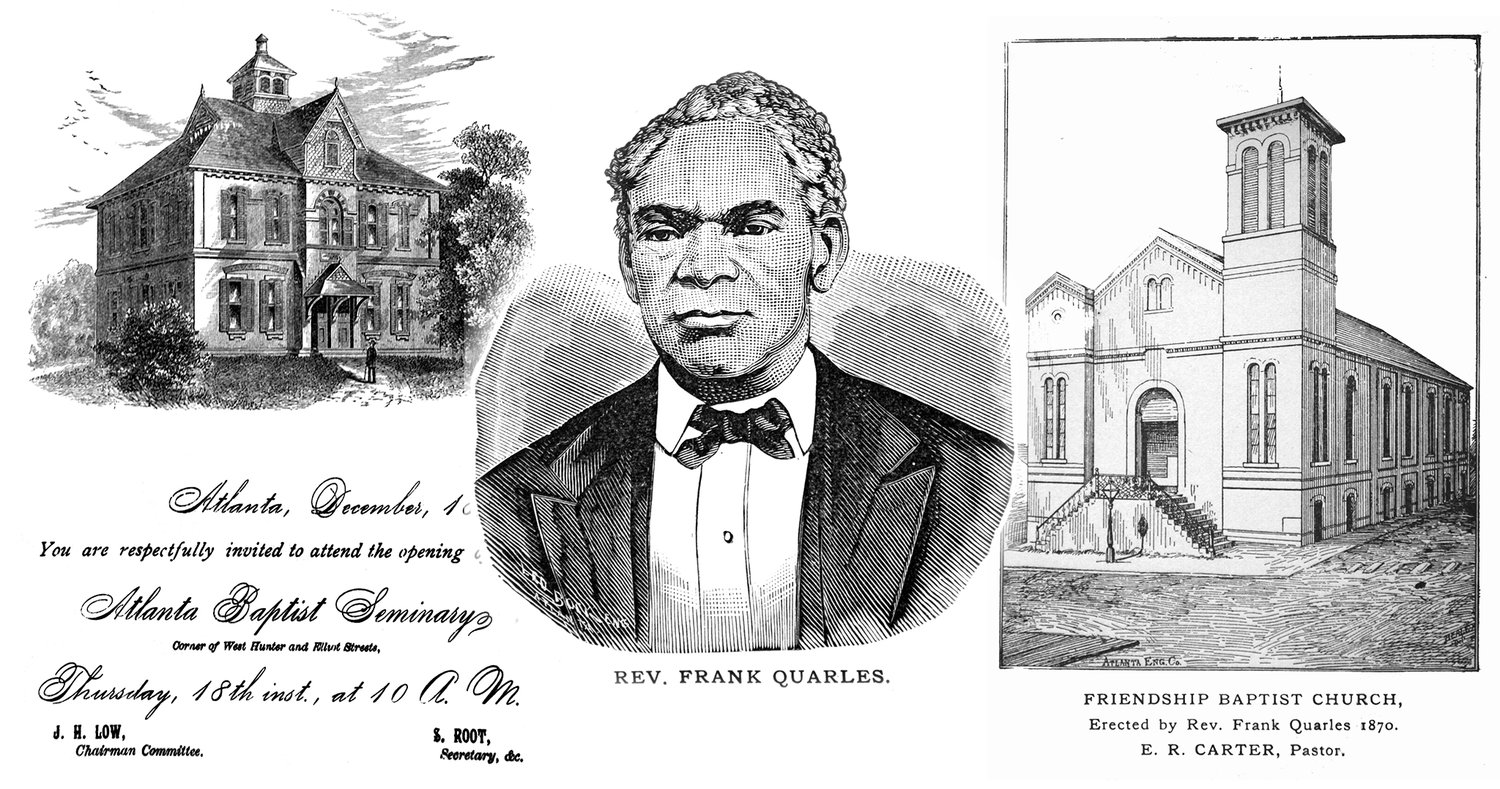
There were few rules, written or unwritten, to guide newly liberated freedmen through the dangerous days of transition following the Civil War. African Americans in Atlanta and across the South were still trying to discover what it meant to be free. Complicating the situation even more in Atlanta was the fact that it was a city laid waste by war.
Black leaders began to emerge to lead the emancipated freedmen forward. Many of those leaders were found in the pulpits of the Black churches of the south. Among the foremost in Georgia was a former slave named Frank Quarles (1819-1881), the founding pastor of Friendship Baptist Church of Atlanta.
Quarles had been born into slavery in Virginia in Caroline County, Virginia, in 1819. Although it was illegal in Virginia at the time, he was taught to read at a young age. Throughout his early life, he took every opportunity to study, often at night, to further his education and awareness of the world beyond the blinders imposed by slavery. At age 14 he had a personal conversion experience and became a member of the First Baptist Church of Richmond.
African American members of First Baptist Richmond organized the Richmond African Baptist Missionary Society. This was the sending body of pioneer African American missionaries Lott Carey and Colin Teague to Liberia in 1821. This church became the spiritual incubator that nurtured Quarles until he moved to Thomasville, Georgia, around 1850. There Quarles was instrumental in helping to enlist both Black and white members to organize the First Baptist Church of Thomasville which began meeting once a month at the county courthouse.
In the early years of the Civil War Quarles relocated to Atlanta. At that time Black and white believers worshiped together, typically, at either First or Second Baptist of Atlanta. Quarles joined First Baptist and was ordained, under the name Frank Ponder, in 1864 and soon withdrew with other Black members forming a “branch church” of First Baptist. It was called the Walnut Springs Baptist Church and was located on Walnut Street. The FBC Atlanta minutes of 1866 dismissing members to constitute the new church mention disposal of “a lot” with funds to be reinvested “in another lot at their discretion.” The Friendship church history notes that Quarles had returned from Macon, where he was living during the siege of Atlanta to a congregation described as “sheep without a fold.”
The Walnut Springs meeting house had been destroyed during the burning of Atlanta. Indeed, it was only the intervention of a Catholic priest that spared the Catholic, Methodist, Presbyterian and First Baptist meeting houses in downtown Atlanta which were being used as hospitals. The local priest had threatened General Sherman not to absolve Catholic Union soldiers of their sin during confession if they destroyed the other church buildings.
Following the war in 1866 records of FBC Atlanta indicate 25 members were released to formally constitute the new church. Prior to this the church, by state law, would have been required to be under the authority of a white congregation. With the help of a northern educator serving under the Atlanta Branch of the American Missionary Union, the church was given a box car purchased with funds from the Ninth Street Baptist Church of Cincinnati, Ohio. It would be the temporary meeting place for Walnut Springs Baptist and Atlanta University.
Under Quarles's leadership, the church grew rapidly from 25 to more than 1,500 fourteen years later at the time of his death. Quarles not only built a church from the ground up in Atlanta, but he was also elected as the first president of the newly organized Georgia Baptist Missionary Convention in 1867, a position he held until his death in 1881.
By 1867 Quarles had, while still in bondage, helped organize three churches: FBC Thomasville, Walnut Springs (Friendship) in Atlanta, and the Saint James Baptist Church, Macon while he lived there during the siege of Atlanta. In his role as pastor of Walnut Springs, which was renamed Friendship Baptist in 1871, he was instrumental in helping plant other churches in Atlanta.
As pastor of Friendship and president of the Missionary State Baptist Convention of Georgia his hand of leadership was pronounced in helping elevate members through education. He helped see the church facilities were used to help establish Atlanta University, one of the first Black colleges of the South. In 1867 he lead in the establishment of Augusta (Baptist) Theological Seminary. When it relocated to Atlanta in 1879 and was renamed Atlanta College, once again the first classes were held in the Friendship church basement. In 1916 Atlanta College was renamed Morehouse College. In 1881 the Atlanta Female Theological Seminary also had its humble beginnings in the basement of Friendship Baptist. The school was later renamed Spellman.
Quarles was at the forefront of raising support for these schools, in particular the latter two which had ties to the GBMC. He also worked to coordinate jointly funded mission work among the freemen by the Missionary State Baptist Convention of Georgia, the Southern Baptist Convention, the Georgia Baptist Convention, and the Northern Baptist Conventions. In 1877 after the establishment of the Georgia Baptist State Mission Board he worked with James DeVotie, a white man, for the coordination of both white and African American state missionaries appointed to serve the freedmen. These missionaries provided support for revivals, Sunday School promotion and Pastor Institutes to train pastors and local church leadership.
Leadership is the recognition of gifts, skills and abilities by peers, and their choice of Frank Quarles was repeatedly seen as a wise choice. Quarles became a regular speaker at the white Georgia Baptist Conventions, promoting and sharing the joint work Baptists were accomplishing together across Georgia. His leadership was key to establishing a healthy working relationship between the races during this time of transition and laying the groundwork for cooperation in the years to come. His leadership should be remembered today for uplifting the newly liberated freedmen and bringing the races together to build the Kingdom of God.
__
Charles Jones is a Southern Baptist historian, retired pastor, and newspaper columnist.
Share with others


