October 2, 2026
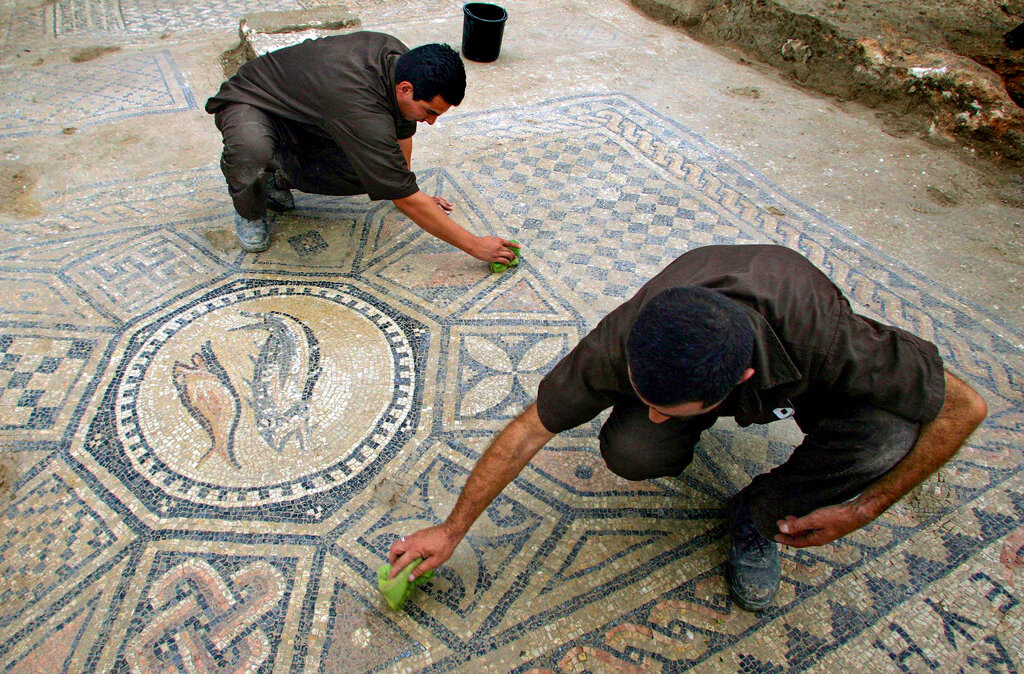
TEL MEGIDDO, Israel (AP) — An ancient Christian mosaic bearing an early reference to Jesus as God is at the center of a controversy that has riled archaeologists: Should the centuries-old decorated floor, which is near what's believed to be the site of the prophesied Armageddon, be uprooted and loaned to a U.S. museum?
Israeli officials are considering just that. The proposed loan to the Museum of the Bible in Washington also underscores the deepening ties between Israel and evangelical Christians in the U.S, whom Israel has come to count on for political support, tourism dollars and other benefits.
The Megiddo Mosaic is from what is believed to be the world's earliest Christian prayer hall that was located in a Roman-era village in northern Israel. It was discovered by Israeli archaeologists in 2005 during a salvage excavation conducted as part of the planned expansion of an Israeli prison.
The prison sits at a historic crossroads a mile south of Tel Megiddo on the cusp of the wide, flat Jezreel Valley. The compound is ringed by a white steel fence topped with barbed wire and is used for the detention of Palestinian security inmates.
Across a field strewn with cow-dung and potsherds, the palm-crowned site of a Bronze and Iron Age city and ancient battles is where some Christians believe a conclusive battle between good and evil will transpire at the end of days: Armageddon.
The Israel Antiquities Authority said that it will decide about the move in the coming weeks, following consultations with an advisory body.
“There’s an entire process that academics and archaeologists are involved with,” said IAA director Eli Eskozido. The organization said that moving the mosaic from its original location was the best way to protect it from upcoming construction at the prison.
Jeffrey Kloha, the Museum of the Bible’s chief curatorial officer, said a decision on the loan would be made solely by the IAA.
The museum “of course would welcome the opportunity to educate our thousands of visitors on important pieces of history such as this mosaic,” he told The Associated Press via email.
Several archaeologists and academics have voiced vociferous objections to the notion of removing the Megiddo Mosaic from where it was found. They balk at the thought of moving the mosaic before academic study is complete.
“It is seriously premature to move that mosaic," said Matthew Adams, director of the Center for the Mediterranean World, a non-profit archaeological research institute, who is involved in digs at Tel Megiddo and the abutting Roman legionary camp of Legio.
Based on other finds found in the dig and the style of the letters in the inscriptions, IAA archaeologists have dated the mosaic floor to the third century — before the Roman Empire officially converted to Christianity and when adherents were still persecuted. Nonetheless, one of the donors who paid to decorate the ancient house of worship was a centurion serving in the adjacent Roman legionary camp.
The mosaic bears Greek inscriptions, among them an offering “To God Jesus Christ.”
The mosaic loan would reinforce ties between Israel and the museum. The museum sponsors two archaeological digs in Israel, has a gallery curated by the IAA. Kloha said the museum also is planning a lecture series featuring IAA archaeologists.
Evangelical Christians, whose ranks have been growing worldwide, have become some of Israel's most fervent supporters, donating large sums of money and visiting the country as tourists and pilgrims. In the U.S., they also lobby politicians in Congress in support of Israel.
Evangelicals, who make up more than a third of the world's estimated 2 billion Christians, say their affinity for Israel stems from Christianity’s Jewish roots.
Since its discovery, the mosaic has remained buried beneath the grounds of the Megiddo Prison. But in recent years the Israeli government has started advancing a multi-year plan to move the prison from its current location and develop a tourist site around the mosaic.
The Tel Megiddo archaeological site is already a major attraction for evangelical Christians visiting the Holy Land. Busloads of pilgrims stop on their way to or from Galilee to see the ruins of a biblical city and pray at the site where they believe the apocalypse will take place.
Neither the IAA nor the museum would discuss the exact terms of the loan proposal, but Eskozido suggested something similar to the decade-long global tour of a Roman mosaic found in the central Israeli city of Lod until Israel had completed a museum to house it.
Share with others


