October 2, 2026
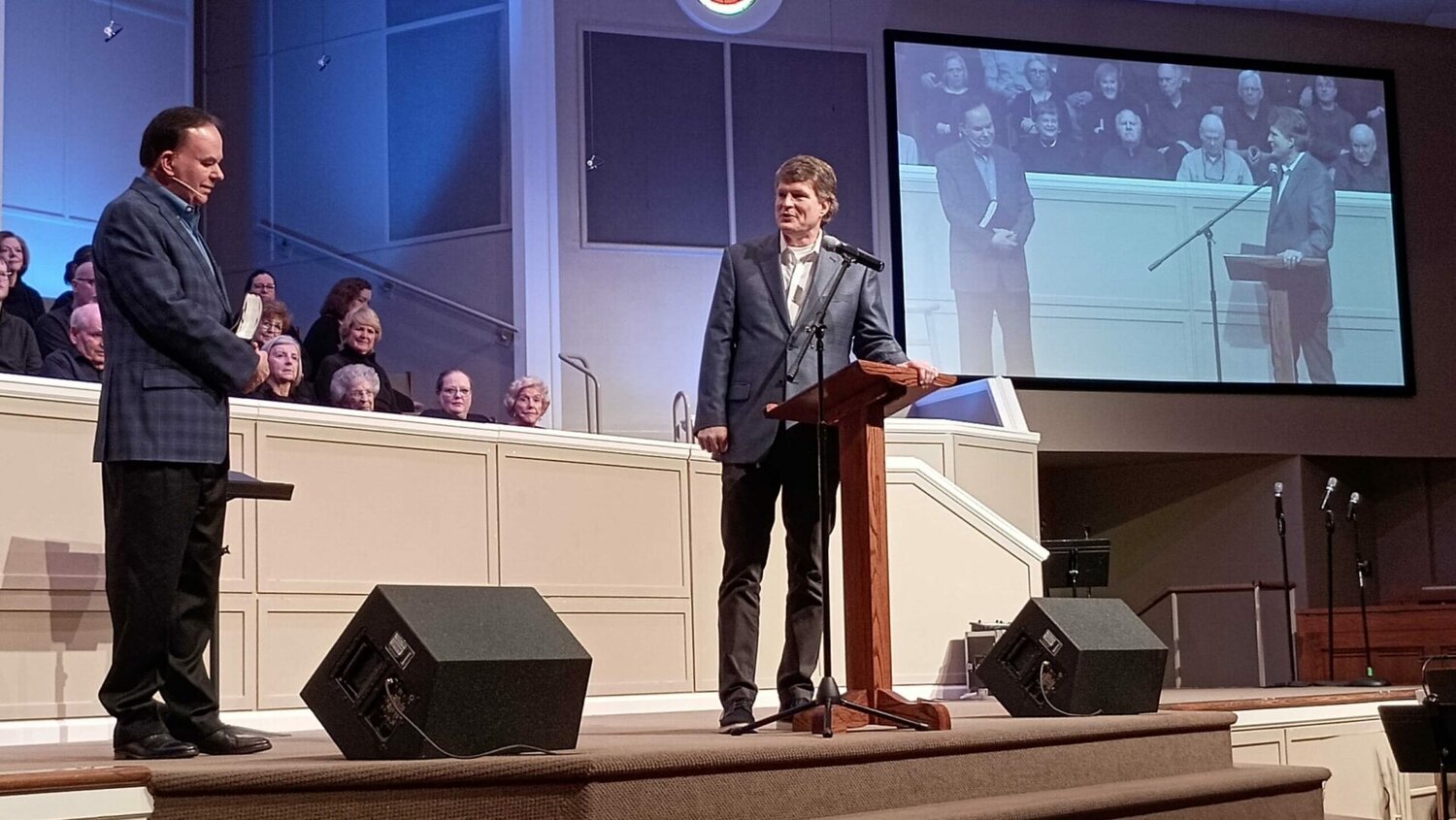
In his introduction, Rick Lance, executive director of the Alabama Baptist State Board of Missions, said Waldrep for 50 years had been both a “minister of encouragement and a master of encouragement.”
During his sermon, Waldrep told about his late grandmother, Linnie, of Colbert County who lived to be 96 and had a circle of friends she called every day. She once told her grandson that she was very disturbed. She explained, “All my high school classmates are dead, and everybody at my church within 20 years of my age is dead. They’re probably all up in heaven thinking, ‘Linnie’s not coming!’”
Waldrep said his grandmother kept her World War II era Bible and recorded dates when she heard sermons from particular passages. One day she questioned her grandson, “Whatever happened to Obadiah?” because she had never heard a sermon preached from that book.
“My grandmother found entire books in her Bible without notations that they’ve ever been preached to her,” he said. “And I discovered that Romans 16 was one of those passages. I began to study it and believe that in it we have the principle that changes everything.”
Waldrep said Romans 16 is Paul’s greeting to his friends in Rome as he planned to visit the church for the first time.
“These 26 or so men and women who crossed his path were his friends and co-workers,” he said. “They loved him, and Paul loved them. The Ephesian elders broke down and wept when Paul left them, according to Acts 20, so we know Paul was a man who loved others, and this love was returned. One of the great problems the church faces is how to make people feel loved.”
Waldrep said we learn from Paul to appreciate people for who they are, not for what they can do for us.
“We might think in this passage Paul saluted the leading citizens and the political elite, but I found in my study that those he affirmed were ordinary people,” Waldrep said. “Half of those in this list were women or slaves. In the Roman world, these people were at the bottom of the social climate. In our modern culture, they’d be like animals who aren’t humans that we respect.”
He said the real test for the church is how they treat beggars and billionaires. “Do we show distinctions? Do we love people according to what they can do for us?”
Secondly, Waldrep noted that Paul acknowledged these people by calling their names.
“How often do we hear people searching for a church say, ‘Nobody spoke to us?’” he said.
“Jesus is the sweetest name we know, but our own name is the second sweetest name we know,” Waldrep said. “John told us to ‘greet the brethren by name,’ and politicians are schooled when they meet people to speak their names three times. We’re not trying to win votes, but trying to win people, so we acknowledge them by calling their names.”
Waldrep noted that in the same chapter, Paul exhorted Christians to greet one another “with a holy kiss.”
“Now, this was before COVID, obviously,” he said with a laugh. “The equivalent today is a warm handshake or a hug. We must greet others warmly and call their names. In this way, we acknowledge their worth to us.”
Finally, Waldrep said Paul affirmed his Roman friends. He actually bragged about what they had done for him and the Kingdom over the years.
“Paul was very specific, and he gave reasons for his feelings,” he said. “Love doesn’t see the faults of others but their strengths. We must learn to see others through the lens of love.”
Waldrep said the most effective form of evangelism is loving people, and we should pray, “God, will you help me love people like Paul loved people?”
___
This story first appeared in The Alabama Baptist.
Share with others


