October 2, 2026
NASHVILLE, Tenn. - As churches continue ministry in the aftermath of the COVID-19 pandemic, many are finding it increasingly difficult to grow their small groups. However, churches continue to report new commitments to Christ and changed lives.
According to a Lifeway Research study, the authority of Scripture is foundational to churches’ groups and discipleship strategies. Almost all U.S. Protestant pastors surveyed say Scripture is the authority for their church and their lives. Protestant pastors have consistently considered Scripture to be the authority for their church and their lives since Lifeway Research began asking this question in 2008.
Even as pastors hold on to the authority of Scripture, it has become increasingly difficult for pastors to move worship attendees into small groups where they’ll study Scripture. On average, Protestant churches say just under half of their current weekend worship attendees are involved in a small group, Sunday School or similar group, indicating a decline in average small group attendance since 2010.
“Small groups and Sunday School classes provide the relational glue that allows a local congregation to be a place where people love one another,” said Scott McConnell, executive director of Lifeway Research. “Groups and relationships that are centered on the Word of God unify a congregation and motivate people to work together on the mission of the church. Churches with few people participating in groups are not in a healthy position to be making more disciples.”
Small churches in particular face significant challenges when it comes to integrating worship attendees into small groups. Pastors at the smallest churches, those with fewer than 50 attendees, are the most likely to say fewer than a quarter of their attendees are involved in a small group.
Pastors of mainline churches are more likely than evangelical pastors to report less than a quarter of attendees involved in groups.
Commitments to Christ and continued discipleship
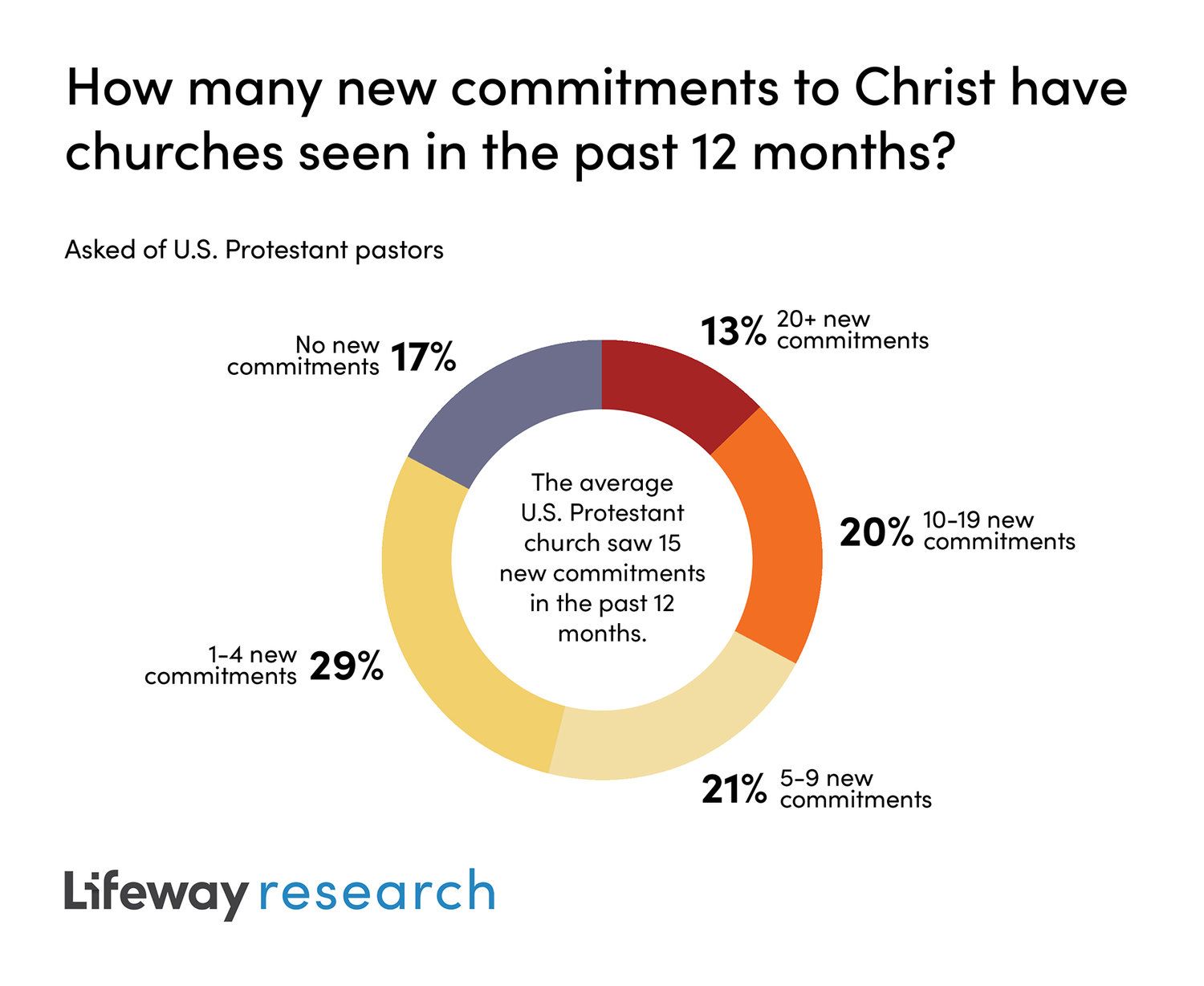
As churches have struggled to develop small group attendees, large numbers of new commitments to Christ are becoming less common. In the past 12 months, Protestant churches have seen an average of 15 new commitments to Christ. Most churches say they’ve seen one to four new commitments in the past year. Fewer are on the extremes of having no new commitments or 20 or more. Compared to 2010, fewer churches today are seeing at least 20 new commitments in a year.
“Previous research has shown people who regularly attend groups share with others how to become a Christian and invite people to church more often,” McConnell said. “As we see less participation in groups, it is not surprising that churches see fewer people coming to Christ.”
Nearly 8 in 10 new commitments to Christ become active in the life of the church., and more than half of Protestant churches say they retained all new commitments. This indicates a slight improvement since 2008.
Once again, mainline churches are more likely than evangelical churches to struggle to gain new commitments.
Church size is a significant factor in new commitments and retaining those commitments in the church. Pastors at churches with attendance of fewer than 50 are most likely to report no new commitments. And pastors at churches with an attendance of 250 or more are most likely to report at least 20 new commitments. However, pastors of those largest churches are the least likely to have retained all new commitments.
As pastors continue to report new commitments to Christ, 9 in 10 Protestant pastors say they are consistently hearing reports of changed lives in their church.
Serving in the church and community
The percentage of adults who attend church at least monthly and have regular responsibilities at the church varies greatly. More then 4 in 10 adults in Protestant churches volunteer regularly. Most churches say at least 20% of adults in their congregations serve regularly in the church. But the number of pastors that say less than 20% of adults in their churches regularly volunteer has substantially increased since 2008.
Small churches have an interesting relationship with volunteers. Pastors at churches with attendance fewer than 50 are simultaneously the most likely to say less than 20% of their adults volunteer in the church and among the most likely to say at least 60% of adults in their church volunteer regularly.
“Some of the smallest churches are hanging on, often for many years, in an unhealthy position of letting a few people serve. In contrast, other churches have an all-hands-on-deck culture,” McConnell said. “The entire tone of a small church can swing quickly if just a handful more people volunteer.”
Compared to the number of volunteers in the church, fewer monthly Protestant church attendees are involved in ministries or projects outside of the church that serve people in their communities.
When it comes to serving in the community, evangelical pastors are less likely than mainline pastors to report a large percentage of participation.
Share with others